

By Lucy Komisar
March 8, 2007
Until now, the giant U.S. telecom accused of bribing former Haiti President  Jean-Bertrand Aristide to get a lucrative phone contract, has managed to keep details of the case under wraps. That is because IDT lawyers succeeded in getting the U.S. District Court Judge, Mark Falk, to gag whistleblower D. Michael Jewett and seal his testimony.
But somehow, three weeks ago — unaccountably in the face of Jewett‘s lawyer‘s unsuccessful attempts to unblock the court record — the statements of Jewett and of the top IDT officials were posted on Pacer, the US government court website.
The defendants’ lawyer had moved for summary judgment and placed all the documents in the record on the Pacer website. She should have filed under seal since some of the material was sealed and because court rules require redaction of all sensitive materials. She didn’t.
What interesting reading those documents make, especially Jewett‘s detailed account of what may happen in a major corporation when a lone employee stands up against corruption.
Excerpts follow, and some of the complete declarations (answers to interrogatories) are linked. For more background about the case, see these past stories.
Michael Jewett says he was fired by IDT because he objected to a deal to provide long distance phone service from the US to Haiti that would grant a bargain rate to IDT in exchange for kickbacks to Aristide. The deal was constructed to send IDT payments not to the Haitian phone company, TeleCo, but to a secret bank account owned by Aristide in the offshore Turks & Caicos Islands. T&C is a tax haven where owners of shell companies and bank accounts enjoy anonymity, which attracts shady customers and swells the profits of the financial services sector.
IDT, which is run by James Courter (shown here), 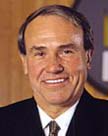 a former Republican congressman from New Jersey, is based in Newark, NJ. IDT officials say Jewett was fired because he wasn’t doing his job.
The IDT-Haiti deal was made in 2003. Jewett, who had been manager for the Caribbean, was fired shortly thereafter. He filed suit in New Jersey for wrongful dismissal. The company has resorted to years of legal delays to keep the case from trial and the details from the public.
Following are excerpts of Michael Jewett’s Nov. 2006 answers to IDT interrogatories. They offer the first details of the general charges he has made in the case. They are followed by the responses of IDT officials, all of whom either say they know nothing about any corrupt deal or that Jewett only joked about it.
Jewett says:
My objections to the TeleCo Haiti deal appear numbers times in the complaint and court papers I have filed in this case.
September 16, 2003, defendant Jack Lerer, Executive Vice President for International Business Development for IDT, told me that he negotiated a deal with the President of Haiti, Jean Bertrand Aristide, to forward telephone traffic to Haiti for 9.5 cents per minute. IDT Telecom would deposit the settlement dollars from terminating traffic in Haiti through TeleCo to an offshore account set up on behalf of President Aristide called Mount Salem Management, headquartered in the Turks and Caicos Islands. I asked defendant Jack Lerer what Mount Salem was and he replied it was the private bank account of the President of Haiti, Jean Bertrand Aristide, that had been created by legal counsel for President Aristide, Adrian Corr, member of the law firm Miller, Simons and O’Sullivan.
I questioned if it was legal for IDT to make settlement deposits into the private offshore bank account of the President of Haiti rather than depositing the settlement proceeds into the bank account of TeleCo Haiti. Defendant Jack Lerer told me it did not matter who got the money as long as IDT was protected from TeleCo Haiti alleging that they had not been paid for terminating IDT’s telecommunication traffic in Haiti.
That same day Mr. Lerer met with me and defendant John Cate, Vice President of International Network Development, to explain the particulars of the deal for purposes of having us perform work to facilitate the deal. Mr. Cate was assigned as technical correspondent and I was to serve as the ‘go-between‘ for all commercial correspondence between TeleCo Haiti and Mount Salem. Mr. Lerer instructed us not reveal the details of the TeleCo Haiti deal with anyone within IDT and I was further directed to work with defendant Alex Schwartz, as legal counsel.
At the conclusion of this meeting with defendant Jack Lerer, plaintiff and defendant John Cate discussed whether or not it was lawful and or legal for IDT Telecom to proceed with the TeleCo Haiti deal, as described above.
Defendant John Cate indicated that at his former employer, ATT, he participated in the preparation of submissions far the Federal Communications Commission (hereinafter FCC”). He stated that during his 27 years at ATT, he had never once been involved with let alone heard of a telecommunication proposal and / or contract being structured in a manner similar to the TeleCo Haiti agreement. We further discussed FGG regulations and Mr. Cate stated that TeleCo Haiti was an ISP country referring to a regulatory policy of the Federal Communications Commission called the International Settlements Policy. I was generally aware of the International Settlements Policy and its requirement that all U.S. carriers conform to a uniform settlement rate with certain countries.
Mr. Cate opined that the contract with TeleCo was set for a price which was below the official settlement rate set by the FCC and for that reason the contract needed to be submitted to the FCC for approval. We then both expressed serious misgivings to one another as to the legality of the proposed TeleCo Haiti contract and what the FCC might do to IDT if the FCC were to learn of the details involving the payment of TeleCo Haiti’s settlement proceeds into the private offshore bank account of President Aristide.
I expressed objections to defendant John Cate as to the legality of the TeleCo Haiti contract both in terms of its payments to offshore accounts and the fact that IDT needed to seek FCC approval of the deal.
In September l6, 2003, defendant David Schropfer, Executive Vice President Strategic Management, met with me and John Cate to express his support for the TeleCo Haiti deal. On that day I expressed objections to David Schropfer on grounds of its payments to offshore accounts and not TeleCo Haiti, it’s discounted per minute rate being below FCC sanctioned guidelines, and the fact that it needed to be filed with and approved by the FCC.
Mr. Schropfer responded to my objections by stating the deal would proceed because it was a Jack deal and that defendant Jack Lerer had the support of the Chairman of IDT, defendant Howard Jonas. He then instructed me to work with defendant Alex Schwarz, Esq., Legal Counsel for IDT Telecom, in structuring the contracts with TeleCo Haiti and Mount Salem Management.
On or about late September 2003, defendant Jack Lerer provided me via email the contact names of Mr. Adrian Corr, signing authority of Mount Salem.
On or about mid to late September 2003, at the direction of defendant David Schropfer and defendant Jack Lerer, I forwarded a draft copy of IDT’s standard Interconnect Agreement to both Mount Salem Management and TeleCo Haiti, via email on behalf of Mr. Lerer as ordered by defendant Mr. Lerer.
On or about mid to late September 2003 and early October 2003, I expressed objections to the legality of the TeleCo Haiti Deal to defendants Jack Lerer, Alex Schwarz, David Schropfer, and John Cate. All objections occurred at IDT offices located at 520 Broad Street, Newark, New Jersey.
At one point when speaking directly to Alex Schwarz in the hallway outside Jonathan Levy’s office on or about late September 2003, I said to him I did not believe the TeleCo Haiti Deal complied with law in that it involved payments to an off shore account and that the discounted price and administration of payments needed to be disclosed to the FCC. In response defendant Alex Schwarz, Esq., stated his doubts about the legality of the deal but said he was just doing what he was told to do.
On or about early October 2003, I forwarded, on behalf of defendant Jack Lerer, to both TeleCo Haiti and Mount Salem via e-mail, Non-Disclosure agreements which were prepared, on information and belief, by defendant Alex Schwarz.
On or about early October 2003, signed Non-Disclosure documents were faxed and delivered by courier between the parties.
On or about early October 2003, I and John Cate had lunch with Peter Shore on more than one occasion and defendant John Cate and I both expressed objections to the TeleCo Haiti Deal. It is believed Mr. Shore resides in Princeton, New Jersey.
In early October 2003, defendant John Cate and I described the terms and conditions of the TeleCo Haiti deal to Miriam Haskell in IDT’s finance department. We both expressed concerns over the legality of the deal to her. Ms. Haskell was equally concerned about the deal as well and that defendant Michael Levine in the Finance Department will never approve the deal. Mr. Cate responded by stating that Mr. Jonas is supporting the deal.
In October 2003, I provided administrative support to Alex Schwarz, Jack Lerer and David Schropfer concerning the contracts for TeleCo Haiti and Mount Salem Management.
In early to mid October 2003, I sent numerous emails on behalf of Jack Lerer and Alex Schwarz, between IDT Telecom and TeleCo Haiti and IDT Telecom and Mount Salem Management for purposes of negotiating and finalizing the terms and conditions of the proposed agreement.
During this time (early October 2003), I repeatedly expressed objection to defendants Schwarz, Schropfer, and Lerer as to the legality of the TeleCo Haiti Deal in terms of its payments to Mount Salem Management (Aristide) and not TeleCo Haiti, and the fact that the discounted deal had to be filed and approved by the FCC. In response they stated, on various occasions, that the most important thing was to ensure that the agreements tied TeleCo Haiti and Mount Salem together so that if something happened to President Aristide, TeleCo Haiti could not sue IDT Telecom for non-payment of settlements.
On or about mid October 2003, I heard defendant Jack Lerer and defendant Alex Schwarz, engage in a conference call with Fred for the purpose of negotiating the per minute settlement rate with TeleCo Haiti and Mount Salem Management downward. [LK: This could be Fred Beliard, a close associate of Aristide.]
In or about mid October 2003, at the direction of defendant David Schropfer, I prepared the deal profile for defendant Jack Lerer which summarized all the salient terms and conditions of the proposed agreement between IDT Telecom, TeleCo Haiti and Mount Salem Management. I requested permission from defendant Schropfer to include my objections to the legality of the deal directly in the deal profile, which request was denied.
At about this time, the IDT defendants who were directly involved in the transaction began to exclude me from meetings and discussions concerning the Mount Salem Management/TeleCo Haiti deal.
On or about the end of October 2003, defendant David Schropfer stopped me from personally circulating the deal profile to and among IDT executives in contravention of normal practice at IDT.
He personally circulated the deal profile to explain the deal and obtain signatures from Defendant Robert Schiff, Director of IDT Telecom Sales, Defendant, Avi Lazar, Senior Vice President of Global Buying, Defendant, Michael Levine, Senior Vice President Finance IDT Telecom and Defendant, Jonathan Levy, President IDT Telecom.
On or about the mid to end of October 2003, I was excluded from a global meeting of the Strategic Management Team that all ARVPs and more senior executives were required to attend for the purpose of discussing global and regional strategies. I was initially instructed to attend the meeting but a few days prior to the meeting I was informed I was no longer permitted to attend. I was not provided any explanation why I was the only ARVP excluded.
On or about late October 2003, Miriam Haskell in the IDT Finance Department advised me that the deal profile had been approved. Shortly thereafter the completed deal profile was available on line as part of IDT’s internal documentation management system. I was however not informed of the final negotiation of the contracts with TeleCo Haiti and Mount Salem Management, in contravention of normal practice at IDT.
On or about the end of October 2003, I was not permitted to send out the final version of the contracts in contravention of normal practice at IDT.
On or about November 5, 2003, I learned of the return of the signed contracts from Mount Salem Management and TeleCo Haiti through a paralegal in the IDT Legal Department, Mark Latourich.
Shortly thereafter I personally confronted Mr. Schropfer with this knowledge and repeated my objection that IDT was proceeding with the deal.
Mr. Schropfer gave no response except to ask how I found out about the signed contracts. On November 11, 2003, I was terminated without notice.
About John Cate VP of International Network Planning
Mr. Cate indicated that all of his correspondence with TeleCo Haiti and Mount Salem Management Ltd required a CC to Mr. Alfonse Inevil, Director General of TeleCo Haiti. Mr. Cate was told by Mr. Jack Lerer, SVP International Business Development, that Mr. Inevil was the brother-in-law of President Aristide and that he would also be receiving personally some of the settlement money IDT was depositing with Mount Salem Management Ltd on behalf of President Aristide.
I asked Mr. Cate if in his 27 year employment with ATT, had he ever been part of a deal like IDT put together with TeleCo Haiti and Mount Salem Management Ltd to which he replied, ATT would never get involved in a deal like this. The FCC would be all over them.” Mr. Cate indicated that the deal in his mind was not only illegal but immoral considering how poor Haiti was.
He asked me whether I thought that Jack Lerer may have had something to do with my firing
John Cate called Jan 9/04. Aristide impatient to have everything up and running
Michael Bloomberg to be in Haiti. John Cate called on Feb14/04:
Haiti – The interconnect is up and running. IDT was passing traffic through the interconnect for testing purposes. By the end of Feb/04 all of the traffic would be going through the interconnect. I asked if they were worried about Aristide being removed or killed…John said that IDT felt that the US government would support him and the deal that IDT had with him would remain intact.
IDT President Howard Jonas‘s interrogatory is a repetitive declination to answer the questions about the TeleCo deal or Jewett‘s firing as “overly broad” and “irrelevant,” protected by attorney-client privilege, etc. CEO James Courter, a former Republic congressman from New Jersey, said the same.
Lerer, Executive Vice President for International Business Development for IDT, said in his interrogatory, “No one communicated any objections to me about the TeleCo Haiti Deal.” And he said he had nothing to do with Jewett‘s firing.
Schropfer Executive Vice President Strategic Management said in his testimony:
In August 2003, I was asked by Jack Lerer to become involved in the execution stage of a possible interconnection with TeleCo Haiti. During this stage, Mr. Lerer informed me that TeleCo Haiti requested that a third party administrator be used for possible payments related to the deal.
I discussed this structure with others and delegated tasks related to implementing the requested structure. During this early stage in putting together the prospective TeleCo Haiti deal, I recall at least one person questioning me as to whether I thought it was appropriate and/or legal to use a third party administrator. In response, I explained that Mr. Lerer told me that the deal’s structure had already been preliminarily approved by Legal, and that the deal would also go to the legal department again for final review before the contracts were ever approved or finalized to make sure it complied with all legal requirements. I also explained that if there was a problem with the deal, the legal department would not stamp it approved and we would not do the deal without the legal department approving the structure of the final contract.
I have no recollection as to who the person was who questioned me about the deal since a number of people were involved in working on different aspects of the deal. Those primarily involved included Mr. Jewett, Mr. Lerer, John Cate, Alex Schwarz and me. Also, two other support personnel were involved. We all met and discussed the deal at various times. The question may or may not have come from Mr. Jewett.
There were no questions or comments made to me or in my presence regarding the lawfulness or appropriateness of-the TeleCo Haiti deal other than what I explained above. I do know that our legal department analyzed the deal to confirm its legality and that it was approved by legal before it was executed. I also know that the deal was approved by legal and was executed prior to the time Mr. Jewett’s employment was terminated on November 11, 2003.
Schropfer noted, “I am the person who hired Mr. Jewett on or about April 15, 2003 and assigned him his job responsibilities. On at least four occasions, Jonathan Levy brought up with me the subject of terminating Mr. Jewett. He did it the last time, just after the deal went through.”
Cate, who shared an office with Jewett, said, “I never heard Mr. Jewett object to the Telco Haiti deal as being unlawful during his time at IDT.” He recalled only that “when we returned to our office following our initial meeting with our manager, David Schropfer, where we were provided with an over view of the deal and received our assignments, Mr. Jewett did make a wisecrack quip that the Telco Haiti deal ˜must be Aristide’s bank account.‘ We both laughed.”
Cate recalled that, “During the meeting, we were told that we would interconnect to the TeleCo Haiti network and that TeleCo’s settlement agent was in the Turks & Caicos Islands, and that we should meet with Jack Lerer for more information. Nothing learned in the meeting with David would support an allegation that the deal was unlawful.”
He said that “the use of settlement clearinghouses by telecommunications carriers is an established industry practice, and it is each carrier’s prerogative to designate the manner in which its settlements are administered and settled. I had seen these arrangements in my career at AT&T.”
He said when he and Jewett met with Jack Lerer later that day and heard “a high level description of the deal…Mr. Jewett repeated his quip and laughed. Mr. Lerer was taken back.”
He said that Lerer said that “the settlement arrangement was requested by TeleCo Haiti, the government owned PTT of Haiti; this is what the Haitian government wants.” Cate remembers commenting that he had seen this type of arrangement many times during his career at AT&T.
He said he never heard Jewett raise the issue of the legality of the deal with him or their superiors, or recommending that they should not go forward with the deal for any reason. Though “On a few occasions Mr. Jewett repeated his sarcastic quip, sometimes at lunch or in with lower level project management employees. Each time he said this, it was in the context of a joke and he never argued, stated or presented any facts that would suggest that he thought that there was anything illegal with the TeleCo Haiti deal. I never took his joke as a serious concern about the TeleCo Haiti deal or as an objection to the proprietary or lawfulness of the deal.”
Bon Bagay. I hope the law goes back in history and addresses all unlawfulness.
Bravo! This is just one more way to tarnish the image of the people’s president. This attempt on the credibility of our president is absurd. This so-called find is just another copy of a novel from Hollywood.
i do not know who you are but i think that THEY have payed you a good amount of money to publish such garbage. In reality I know your motives; but I want to ask you why? Why?
Many more things I wanted to say to you, but another time certainly.
I believe that the story of Michael Jewett may carry a lot of truth. I was also expelled from the same department as Michael Jewett. David Schropfer was also my manager and he also left IDT in a way I never understood and a few months after, that division was closed and some of us were expelled. I have since gone for a legal suit against IDT in South Africa. My case is also still pending for more than a year now because IDT is delaying my dismissal case, they have been dragging and kind of not willing to go for pretrial talks.
The truth seems to be that Lucy Komisar was paid by the Haiti Democracy Project (HDP) to continue this “investigation.” The only smoking gun she continues to push like so much scandalous crack ( pandering to people’s guillibility and baser instincts) is a disgruntled employee with everyone else scratching their heads. Her masters at HDP know there’s nothing more to it but have a pathological hatred towards Aristide. Remember Timothy Carney was a founding member of HDP and he’s now been rewarded for his role in Haiti by being named the chief of reconstruction projects by the Bush administration in Iraq.
For a great interview and opposing POV on the HDP/Komisar connection pleae listen to :
http://aud1.kpfa.org/data/20070314-Wed1700.mp3
I’m still waiting for Lucy to deny that she’s been paid by the HDP. Following her denial, we get down to the real issues behind her persistence on this issue, James Morrell notwithstanding.
LK: The initial report on the Aristide kickbacks was commissioned by the Haiti Democracy Project, and it says so at the top of the report.
The evidence documented there (and linked) is based on far more than the report of a former employee of one of the companies that paid kickbacks.
Timothy Carney is a former ambassador to Haiti, which he why he got the reconstruction task.
KPFA agreed to give me equal time. I asked to appear together with Ira Kurzban, who was featured on the cited broadcast, but was offered only a solo slot. He did not agreed to a format in which his statements could be challenged. Then the offer of equal time was withdrawn, so I have never had an opportunity to challenge the attacks on me. So much for fair-minded media.
The real issue is that I, for ten years, have investigated corruption enabled by the offshore system. The Aristide-Teleco case fits the bill.
Pingback: IDT’s imaginary “ethics letter” | The Komisar Scoop