The FCC hits James Courter’s IDT with a $1.3M fine for a cloudy deal in Haiti.
IDT, the New Jersey telecommunications outfit run by one of John McCain’s top fundraisers, Jim Courter, was fined $1.3 million by the Federal Communications Commission for failing to file a contract for telephone service to Haiti in 2004.
Courter, a former New Jersey Republican congressman, is one of 20 McCain national finance co-chairs, and joined the campaign in February 2007. He’s a Trailblazer for McCain, meaning he raised at least $100,000. The IDT PAC has contributed $84,850 in 2008.
IDT‘s work with Haiti has been put under scrutiny since a former employee, Michael Jewett, then IDT’s manager for the Caribbean, sued the company. His suit claims he was fired when he balked at negotiating a scheme that routed a portion of the company’s long distance revenue from Haiti calls to a shell company, Mount Salem in the Turks & Caicos, which he was told was owned by then-president Jean-Bertrand Aristide.
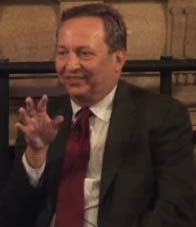
Lawrence Summers spoke at the Council on Foreign Relations last week and was a bit uncomfortable about my question regarding Clinton administration anti-money-laundering policy.
I pointed out that Treasury Secretary Robert Rubin (who happens to be one of the Council‘s co-chairs) had not acted against money-laundering because he didn‘t want to stop the free flow of cash into the US – in effect, into Wall Street. But when Summers succeeded Rubin in the job, he had taken action.
The facts are important because Rubin is poised to move into a Democratic administration — especially if Clinton wins — as a high-level Wall Street influential.
It‘s not just about buying or selling sex. It’s also about money laundering. New York Governor Eliot Spitzer’s downfall began with an investigation by the Internal Revenue Service. That‘s because when people move money for illicit purposes, they try to disguise the flows. And US banks are required to report suspicious transfers to the Treasury Department.
The IRS gets involved, because those transfers could be effected to hide income from taxes. So it responded to bank reports of suspicious transfers by Spitzer, who was paying thousands of dollars for call girl services. The money was being sent to QAT consulting, a shell company owned by the Emperor‘s Club V.I.P. prostitution ring.
Then the FBI joined the United States Internal Revenue Service-Criminal Investigative Division, looking into what appeared to be at first possible government corruption but then turned out to be payments to an organization running prostitution. And also laundering money in the United States and Europe.
Tony Defries, the rock manager who launched David Bowie and who takes credit for managing, marketing and branding such rock stars as Lou Reed and John Mellencamp as well as being “present at the birth of Madonna [and] the reincarnation of Stevie Wonder,” might be making some headlines of his own soon. (He is shown here in 1972 with Bowie’s wife Angie on his right.)
The ex-impresario, a Brit who now lives in Los Angeles and who for a promoter is unaccountably interview- and camera-shy, was one of the beneficiaries of a fake annuity scheme organized by a Swiss bank and its partner, a pseudo insurance company whose main product seems to be tax evasion. But the benefit turned out to be a disaster.
When there’s a financial crisis tied to lack of transparency, follow the culprits offshore. Evidence comes out now that this is true about the subprime debacle.
Reuters reports that a German bank is implementing accounting changes including consolidation of an offshore conduit whose soured investments triggered a government-led rescue. The offshore operation was set up to invest in subprime mortgages.
Pam Martens in Counterpunch points out that, Citigroup, is discovered to have stashed away over $80 billion of Byzantine securities off its balance sheet in secretive Cayman Islands vehicles with an impenetrable curtain around them.
Among those securities count subprimes. Citigroup has $55 billion of subprime exposure and in November said it would write down up to $11 billion in subprime losses. Goldman Sachs said that won’t be all, that the bank may have to write off $15 billion.
Oct 23, 2007 – In the continuing saga of the Frigates of Taiwan, involving about $1 billion in bribes and kickbacks paid by the French company Thomson to win a bid on the sale of six war frigates to Taiwan in the early 90s, I asked French Finance Minister Christine Lagarde, at the Council on Foreign Relations yesterday, if she would continue the cover-up on a corruption case that could be the largest (known) in French history.
Madame Lagarde wasn’t sufficiently aware of the case that has been exhaustively reported by French print and broadcast media for more than a decade.
Click above to see a 6-minute video of Prof. Stiglitz, Nobel Laureate, former Chief Economist of the World Bank, former head of the Council of Economic Advisors to President Clinton. He explains what is wrong with tax havens.
It‘s that time of the year when the UN General Assembly opens and heads of state and foreign ministers meet up at parties and quiet gatherings and even give a few public speeches around town. A popular stop is the Council on Foreign Relations, where anyone representing an establishment view is assured of a warm welcome.
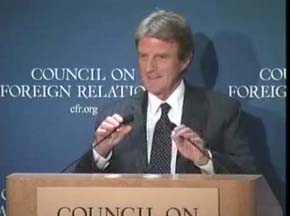
French Foreign Minister Bernard Kouchner, famous as the founder of Médecins Sans Frontieres (actually he was one of 12 doctor and journalist founders), spoke at the Council on Tuesday. In his introduction Felix Rohatyn, the prominent investment banker, US ambassador to France in 1997-2000 and now an advisor to the chairman of Lehman Brothers, said, “There are very few people who act according to their principles. Bernard Kouchner acts on his principles, and that‘s a very rare virtue, especially in a politician.”
I was hopeful that Minister Kouchner, a Socialist who has joined a conservative government, would display these principles in his answer to my question about a corruption scandal that could be the French Watergate. However, the minister displayed the not-so-rare political attribute of solidarity with high-level officials who want to suppress evidence of corruption.
There’s an astonishing article in the Washington Post’s Business Section (Risk. Now They See It. Now You Don’t.Sept 16, 2007)
The Post, which has never, ever, railed against tax havens, is now suggesting that their use to cheat tax authorities and investors threatens the entire global financial system. Of course, it doesn’t put it so starkly, but that’s the gist.
The Post says, Over the past few years, major banks figured out how to use conduits and structured investment vehicles to earn big fees while playing cute little games of tax and regulatory arbitrage and keeping it all pretty much hidden from investors.
Where does The Post think those off-balance-sheet investment vehiclesare?Most of Enron’s were in Grand Cayman. The Post should connect the dots. Tax and regulatory arbitrage plus hidden plus off-balance-sheet investment vehicles = offshore.
Why did regulators tolerate the use of offshore? Because global tax evasion and avoidance of regulation is something corporations want. That’s what offshore secrecy is for. Now, will Congress act, in spite of corporate power, when there is a threat to the entire global financial system?
U.S. officials from the Securities and Exchange Commission, the Justice Department and the Federal Bureau of Investigation met with Munich prosecutors this week regarding the 1.3-billion-dollar bribe fund run by Siemens, the German multinational technology company.
After talking to the Germans about tracking the financial flows of the largest illicit slush-fund ever discovered, the U.S. investigators would do well to visit Luxembourg on Germany’s western border.
There they could seek information from Clearstream, the international financial clearing house, that might tell them how Siemens moved so much money and where it went. That is because Siemens has the unusual status of being one of only four non-financial companies among 2,500 Clearstream members. It gained membership on the insistence of a former CEO who was fired after a scandal.
Siemens, the German-based multinational technology company that made massive payoffs to get international contracts, has, according to the German press, a bribery slush fund of more than $1.3 billion. It moved money through a network of front companies, mostly in offshore Liechtenstein and the United Arab Emirates. Siemens is being investigated by the U.S. Justice Department and the Securities and Exchange Commission as well as by public prosecutors in Germany and Italy.
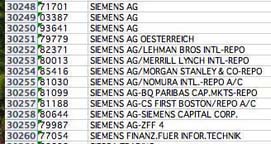
How did Siemens officials move so much money about? Investigators ought to take a look at Siemens‘ transactions through Clearstream, the international financial clearing house in Luxembourg, whose clients do not undergo the same due diligence scrutiny that regular banks apply.
Siemens is one of only four non-financial companies (out of 2500) with Clearstream accounts. Here — published for the first time — are listings of Siemens’ Clearstream accounts for 1995, 2000 and 2001.
Where did Rupert Murdoch get $5 billion to buy up the Wall St. Journal? Beyond normal profits, his coffers were stuffed by dodging taxes in the U.S. and elsewhere. Some of that is your money!
The Economist, in 1999, investigated Murdoch’s corporate tax affairs and discovered that a collection of 800 offshore companies help him cut corporate taxes to 6%!
Speech to conference on Taming the Giant Corporation, organized by Ralph Nader and The Center for Study of Responsive Law, Washington DC, June 8, 2007
The tax haven racket is the biggest scam in the world. It‘s run by the international banks with the cooperation of the world‘s financial powers for the benefit of corporations and the mega-rich. This talk is about strategy, but first you have to know the target, and most Americans, including progressive activist Americans, don‘t know what I‘m going to tell you. And that‘s part of the problem.
Between 1996 and 2000, of U.S. and multi-national corporations operating in the United States, with assets of at least $250 million or sales of at least $50 million, nearly two-thirds paid no U.S. income tax. Over 90 percent reported owing taxes of under 5 percent. One year, six in ten paid less than a million.
This is the dirty little secret of globalization: the end of controls on capital flows and the expansion of the tax haven system from 25 years ago to where it has more than doubled to about 70 tax havens.
The system is a major reason for the growing inequality in the U.S. and between the West and the developing worlds.
The system has given the big banks and corporations and the super-rich mountains of hidden cash they use to control our political systems.
President Bush‘s attorney general, Alberto Gonzales, has come under fire for politicizing the U.S. Justice Department for his dismissals of eight U.S. attorneys, apparently because they didn‘t target Democrats. But using the Justice Department for political ends isn‘t simply an invention of Gonzales or of the President; it‘s an old Bush family tradition.
In politicizing the Justice Department, Bush takes a page from his father. The George H.W. Bush Justice Department 25 years ago balked at investigating and prosecuting the key players in the scandal of the criminal, terrorist-friendly bank, BCCI, and moved only, and in limited fashion, after New York District Attorney Robert Morgenthau forced its hand.
Bush had a strong reason to want Justice to block pursuit of the case: the CIA used BCCI for its black ops, including funneling some of the $2 billion Washington sent to client Osama bin Laden and running money for the illegal Iran-Contra operation.
When it comes to tax cheats, the government has been vocal about catching the little guys but doesn’t spotlight the big-time frauds, like Swift Boat financier Sam Wyly (shown here), who happens to be a top-tier Republican contributor.
Wyly cheated the U.S. of at least $300 million in taxes. The money that paid for the Swift Boat campaign was your money!
But Wyly was not only the financier of the scam to discredit John Kerry during the 2004 presidential campaign. He and his brother were George W. Bush’s ninth greatest career contributors, Bush Pioneers, who collected $100,000 for the 2000 and 2004 presidential campaigns. They also funded other leading Republicans. Sam Wyly, since 1997 has given Republicans more than $1 million and his brother Charles and wife have donated more than $1.3 million. That‘s your money!
Wyly did his cheating through an offshore scheme that hid $1 billion in family profits via Isle of Man shell companies that existed only on paper, were registered under front men to hide the Wylys’ names, and were used to carry out transactions and launder money. And that’s only the hidden income that was found. The Dallas mogul, with a $1 billion admitted net worth, may be guilty of the biggest personal tax fraud in U.S. history.
The NY Times reports today that Charles Prince, CEO of Citigroup, is planning to cut the corporation‘s compliance staff. Reporter Eric Dash says it‘s “to keep the bank from getting bogged down” because “the compliance overhang has made it difficult to be competitive” and “unnecessarily slowed the company down.”
Translation: other banks are laundering profits or running scams to help clients cheat tax authorities and investors, and they make good money at it. Why shouldn‘t we?
Dash noted that Citigroup had beefed up its compliance staff after scandals, including its dealings with Enron. He skimps on details: that Citigroup set up offshore shell companies to help Enron cook the books.
Los legisladores de Estados Unidos que investigan la veracidad de los argumentos del presidente George W. Bush para invadir Iraq deberÃan analizar una de sus afirmaciones más resonantes: la del vÃnculo entre Saddam Hussein y Osama bin Laden.
Los crÃticos de Bush desacreditaron tal aseveración, a la que calificaron de invención. Estaban equivocados. El vÃnculo existÃa, pero no era el que el presidente le vendió al público.
Russia, through its energy company Rosneft, has started to recover the multibillion-dollar oil company Yukos that was stolen from it in the mid-90s. It is buying the assets in auctions. Indignant protests are heard from westerners.
Funny there was no indignation from western officials when Mikhail Khodorkovsky and other oligarchs, with the help of crooked President Boris Yeltsin, were appropriating Russian national oil and mineral wealth for kopeks on the ruble.
A Khodorkovsky company ran an auction at which a Khodorkovsky shell company won Yukos, paying $309 million for a controlling 78 percent. Months later, Yukos traded on the Russian stock exchange at a market capitalization of $6 billion.
Swiss travel the world to help mega-rich evade taxes
The NY Times headline yesterday said, “Discreet Swiss Banks Now Offering Sophisticated Investment Vehicles.” Further down, the story noted that Geneva has becomes an “aggressive haven for the global elite.” And, “Now the Swiss can be found throughout the world, selling more sophisticated investment vehicles to attract high-net-worth individuals, mostly multimillionaires.”
So what is the real story about? The headline should have been, “Discreet Swiss travel the world to help the mega-rich evade taxes.”
How else has bank-secrecy Switzerland, with only 7.5 million people, become the third-largest asset manager in the world, after the United States and Britain, with global banking assets under management of $5.5 trillion?
Is Citibank Spain a tax cheat?
New Internationalist, Aug 2006
With help from a whistleblower, I followed the money trail through the offshore operations of Citigroup, the world‘s biggest bank, and discovered that Spanish bankers handling their client’s offshore accounts were getting commissions via an internal accounting system instead of on the regular books.
It is the same internal system that Citigroup used in the 1970s to compensate currency traders in Paris, London, Frankfurt and elsewhere who booked trades in the tax haven Nassau, the Bahamas. They were exposed by an insider, were investigated by the SEC and Congress, and had to pay millions in back taxes. Is this happening again?
This report describes and details a history of tax evasion by the world‘s largest
financial conglomerate, Citigroup. Going back decades, it is a story of
repeated, aggressive tax evasion for itself and clients, depriving governments
and therefore citizens of huge amounts of funds and carried out with relative
impunity.
Who might have killed former Russian spy Litvinenko? Julia Svetlichnaya, a Russian living in London, told the press there that she had met Litvinenko and learned that he was collecting information about mega-rich Russian entrepreneurs to use for blackmail.
It has not been reported before that Litvinenko’s collaborator, Yevgeny Limarev, had visited Elena Collongues-Popova (shown here), a Russian woman in Paris, to seek information connecting ex-Yukos official Alexei Golubovich to bribery of the former president of Lithuania. And Svetlichnaya hasn’t told the press that she worked for the very same Golubovich.
The company is under investigation by the SEC, the United States Attorney in Newark, New Jersey, and a U.S. federal grand jury for allegedly paying bribes to Jean-Bertrand Aristide, former president of Haiti. Five nationally prominent US Republicans, the independent board members of a corporation that has been charged with paying hundreds of thousands of dollars in bribes to get a sweetheart telecom deal in Haiti, are leaving its board. The company is IDT, the world’s third-ranked international phone company.
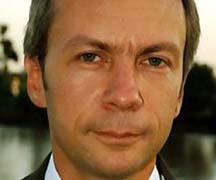
IDT is run by James Courter (shown here), a former New Jersey Republican congressman. The other Republicans are Rudy Boschwitz, former senator from Minnesota; James S. Gilmore III, former Virginia governor; Thomas Slade Gorton III, former senator from Washington State; Jack Kemp, former congressman from New York and 1996 vice presidential nominee; and Jeane Kirkpatrick, the former U.S. ambassador to the UN under President Ronald Reagan.
The U.S. Justice Department is withholding agreement to share assets seized from Haitian drug traffickers to finance a lawsuit by the Haitian government charging former President Jean-Bertrand Aristide with taking bribes.
The suit is based on allegations by a former executive of the telecom company IDT that before Aristide left the country in 2004, he took hundreds of thousands of dollars in kickbacks from IDT, which is connected to prominent U.S. Republicans.
Sept 18, 2006 Is top Justice official protecting a former client accused of bribery?
The Justice Department’s Criminal Division, headed by a Bush political appointee who gave legal advice to a company accused of bribing Haiti’s former president, is blocking an agreement to share seized Haitian drug money that would help Haiti pursue the bribery case in U.S. courts. The accused company is run by a former Republican congressman.
The Criminal Division chief, Alice Fisher, formerly a registered lobbyist for HCA, the healthcare company founded by the father of Republican Senate Majority Leader Bill Frist, is a recess appointee. Her approval was blocked by Senators concerned about her qualifications and about her participation in a government meeting on abusive interrogations at the U.S. military prison camp at Guantanamo.


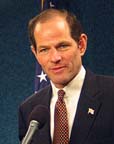 laundering. New York Governor Eliot Spitzer’s downfall began with an investigation by the Internal Revenue Service. That‘s because when people move money for illicit purposes, they try to disguise the flows. And US banks are required to report suspicious transfers to the Treasury Department.

 It moved money through a network of front companies, mostly in offshore Liechtenstein and the United Arab Emirates. Siemens is being investigated by the U.S. Justice Department and the Securities and Exchange Commission as well as by public prosecutors in Germany and Italy.
  Bush had a strong reason to want Justice to block pursuit of the case: the CIA used BCCI for its black ops, including funneling some of the $2 billion Washington sent to client Osama bin Laden and running money for the illegal Iran-Contra operation.
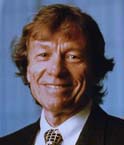 (shown here), who happens to be a top-tier Republican contributor.
 Reporter Eric Dash says it‘s “to keep the bank from getting bogged down” because “the compliance overhang has made it difficult to be competitive” and “unnecessarily slowed the company down.”
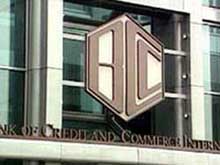 El punto de contacto entre el hoy ejecutado dictador de Iraq y el hoy prófugo lÃder terrorista era el Banco de Crédito y Comercio Internacional (BCCI), cuyas vinculaciones atravesaban toda Arabia Saudita y llegaban hasta el propio presidente Bush y su padre, el ex mandatario George Bush (1989-1993).
 Yukos that was stolen from it in the mid-90s. It is buying the assets in auctions. Indignant protests are heard from westerners.
 Further down, the story noted that Geneva has becomes an “aggressive haven for the global elite.” And, “Now the Swiss can be found throughout the world, selling more sophisticated investment vehicles to attract high-net-worth individuals, mostly multimillionaires.”