Audio/Video, Corporate Abuses, Featured, Regulation & enforcement
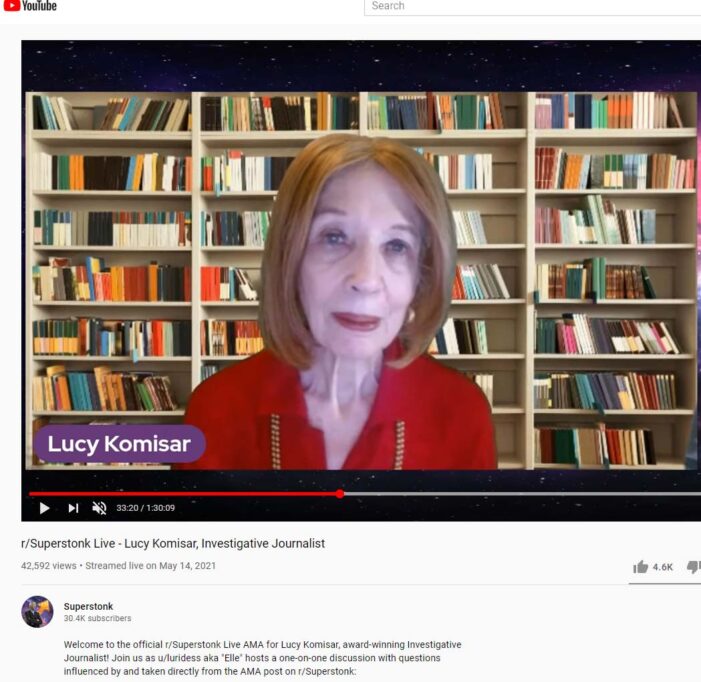
May 20, 2021 – My interview on youtube tells through three dramatic stories how corrupt brokers, hedge funds and their accomplices in government and the media steal from stock market investors. This article includes some of text.
Audio/Video, Corporate/Wall St., Regulation & enforcement, Scoops

Feb 1, 2021 – How to understand the GameStop Robinhood stock spike. It says a lot more about the corruption of the stock-trading system than you have read about in corporate media.
Blog, Corporate/Wall St., Regulation & enforcement, Reporting
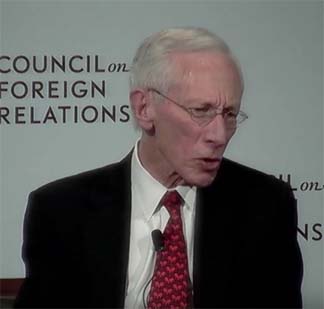
Feb 2, 2016 – At the Council on Foreign Relations yesterday, I pointed out to Stanley Fischer, Vice Chairman, Board of Governors of the Federal Reserve, that the current low unemployment rate he cited in his talk doesn‘t mean what it did when workers had good manufacturing jobs – when now the employed are often working for the minimum wage and need government aid. Shouldn’t the Fed put out those numbers? He avoided answering the question.
Regulation & enforcement, Scoops
100Reporters, March 19, 2012 – One could be forgiven for thinking that the New York State Legislature was a criminal enterprise. It had its mafioso style assemblyman, Democrat Tony Seminerio, telling a prospective “client” that he would “bury” him unless he paid off.
It had entrepreneurs like Democratic Senator Pedro Espada Jr., who set up a community health operation and, prosecutors say, looted it for millions.
It even had a comical nickel-and-dime guy, Democratic Assemblyman Brian McLaughlin, who sent one of his staffers driving on the New York Thruway with his E-ZPass so that McLaughlin could fake time in Albany and collect per diem payments.
New York State has rules against some of those practices, but rarely were they enforced against legislators who were collecting huge sums of cash from companies that wanted laws passed or state contracts awarded.
Offshore, Regulation & enforcement, Scoops
The American Interest, Jan-Feb 2011 (online Dec 9, 2010)
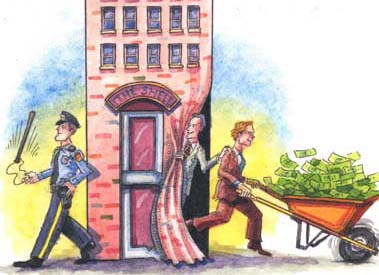
Corporate secrecy, which involves hiding the identities of company owners from tax and other legal authorities, is itself no secret. It is well known that offshore banking centers such as Switzerland, Liechtenstein and the Cayman Islands have for many years enabled fraudsters all over the world to carry out scams, launder illicit profits, stash stolen loot and hide money from tax authorities.
What most people do not know, however, is that there is a vast and growing American offshore. Foreign crooks prize states such as Nevada, Wyoming and especially Delaware for state laws that don‘t require them to list owners or even company officials when a new company is formed. Corporate interests and the Obama administration are blocking congressional efforts to change that.
Featured, Major Past Articles, Offshore, Regulation & enforcement, Scoops

Barron’s, Sept 20, 2010 –
Scoop summary: Howard Jonas, CEO of U.S. telecom IDT, in an interview with Lucy Komisar, acknowledges for the first time that then Haiti President Jean-Bertrand Aristide in 2003 met with an IDT official during discussions about a contract to pay Haiti Teleco for calls from U.S. customers. That contract included agreement for IDT to send payments to a shell company in the offshore Turks and Caicos Islands. Jonas said IDT got an ethics letter from a law firm clearing the deal, but the lawyer said in a memo filed with the court, published here for the first time, that he simply told IDT to do due diligence. IDT signed the contract the next day.
A former IDT official, who objected to the deal, was fired and is suing the company; trial is set for Nov 9th. The Justice Department and Securities and Exchange Commission are investigating violation of the Foreign Corrupt Practices Act. Jonas’s revelations are likely to have a major impact in the trial and investigations.
Banks, Offshore, Regulation & enforcement, Scoops
Inter Press Service (IPS), Feb 3, 2010 –
The global bank HSBC may be running offshore accounts for central banks. According to a U.S. Senate investigation, an HSBC subsidiary in London called HSBC Equator Bank had a sister bank in the Bahamas.
According to an internal e-mail, the bank told HSBC USA it had been providing offshore accounts to central banks for 20 years, because the banks wanted to avoid Mareva injunctions, legally enforceable orders to freeze funds.
Corporate Abuses, Corporate/Wall St., Regulation & enforcement, Scoops
Oct 22, 2009 –
Back in 2004, when Chris Christie was the U.S. Attorney for New Jersey, his office first heard allegations that IDT Corporation, a Newark, N.J.-based global telecommunications company, was involved in a case of international bribery. No federal criminal case was ever brought against IDT, in contrast to several successful federal prosecutions in similar cases elsewhere. The company is run by James Courter, a former Republican congressman from New Jersey.
Fast forward to the present, and Christie is now the Republican candidate for the governor of New Jersey. And, an examination of campaign finance records shows, Christie has thus far racked up $26,800 in campaign contributions – earning him a total of $80,400 including state matching funds ” from 27 individuals who could have a direct interest in the IDT case.
Regulation & enforcement, Scoops
Inter Press Service (IPS), July 14, 2009 – At a recent conference in Miami organised by Offshore Alert, a specialised media organisation focused on financial crime, IPS sat down with veteran investigator Bob Roach to discuss the hurdles facing regulators trying to crack down on tax havens, which cost the U.S. alone an estimated 100 billion dollars annually.
Featured, Major Past Articles, Offshore, Regulation & enforcement, Scoops
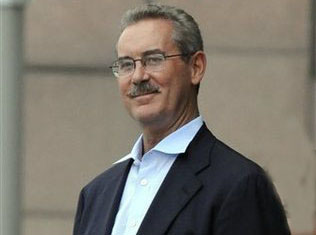
State aided suspect in huge swindle
Miami Herald, July 5, 2009 –
Winner of the Gerald Loeb award, the most important prize in financial journalism
Years before his banking empire was shut down in a massive fraud case, Allen Stanford swept into Florida with a bold plan: entice Latin Americans to pour millions into his ventures ” in secrecy.
From a bayfront office in Miami in 1998, he planned to sell investments to customers and send their money to Antigua.
But to pull it off, he needed unprecedented help from an unlikely ally: The state of Florida would have to grant him the right to move vast amounts of money offshore ” without reporting a penny to regulators. He got it.
Offshore, Regulation & enforcement, Scoops
Inter Press Service (IPS), May 8, 2009
– Jeffrey Owens, the tax point person of the Organisation for Economic Cooperation and Development (OECD), was stung by activist critics of the OECD standards under which countries will be put on a tax haven blacklist and targeted for sanctions.
The blacklist was announced last month at the London meeting of the G20, which said in a communiqué that it would take action against non-cooperative jurisdictions, including tax havens…to deploy sanctions to protect our public finances and financial systems.
Key civil society criticisms are that the OECD standards require bilateral agreements for information on request, not automatic multilateral tax information exchange; that they call for only 12 such agreements to be signed by each tax haven; and that getting off the blacklist entails only promises, which have not been kept by tax havens in the past.
Offshore, Regulation & enforcement, Scoops
Inter Press Service (IPS), April 30, 2009 – The U.S. Internal Revenue Service (IRS) is hitting pay dirt with a novel legal tactic designed to catch tax evaders. And it’s going to use it to force international banks to give up the names of tax cheats. It’s called the John Doe summons. Using John Doe means the IRS doesn’t know the names of the suspected tax evaders. So it sends a summons to a bank or credit card company that says, Give us the names and account information of all your U.S. clients with secret offshore accounts. Daniel Reeves, an IRS agent in charge of the tax agency’s offshore compliance initiative, afforded an unusual look into the broad swath of projects that seek tax-cheating John Doe’s every place from accounts of the giant Swiss bank UBS to the records of Pay Pal.
Offshore, Regulation & enforcement, Scoops
Inter Press Service (IPS), March 29, 2009 –
This could be the moment when a fatal blow is delivered to the world’s tax havens. Or it could be another largely cosmetic change that allows offshore financial centres such as Switzerland, the Cayman Islands and Liechtenstein to deflect attacks on the system by sacrificing the few tax miscreants that governments catch in their nets.
Decisions at the G20 government leaders meeting in London Apr. 2 will set the direction.
Offshore centres, worried what may happen in London, are falling all over themselves promising to cooperate with the major powers on the trail of tax cheats. But the holes in the tax havens’ promises are as big as those in Switzerland’s famous cheese.
Many believe that automatic exchange of information is the only really effective way to end pandemic tax evasion. Some very good proposals are made in a leaked French paper which is linked to the full story.
Corporate Abuses, Regulation & enforcement, Scoops
How food-service providers like Sodexo bilk millions from taxpayers and customers
In These Times, March 2009 –
The Investigative Fund at the Nation Institute provided generous support for this article.
At the end of the 2006 school year, children‘s nutrition advocate Dorothy Brayley had a disturbing conversation with a local dairy representative. He had come to her office to discuss participation in the summer trade show of food providers she runs as director of Kids First Rhode Island.
At the time, the state‘s schools were buying 100,000 containers of milk each week. The salesman for Garelick Farms, New England‘s largest dairy, told Brayley that Sodexo”a food and facility management corporation that managed most of the state‘s school lunch programs”was paying Garelick more than competitors in order to get a bigger rebate.
That‘s just a taste of the hundreds of millions of dollars of “rebates””or kickbacks from suppliers”that Sodexo, a $20 billion-a-year global leader in the food and facility management industry, has taken while operating cafeterias and other facilities for schools, hospitals, universities, government agencies, the military and private companies across the country, according to evidence provided by whistleblowers and internal company documents.
Blog, Offshore, Regulation & enforcement
Feb 11, 2009 –
The U.S. government might finally get a powerful tool against offshore tax evasion by mega-wealthy individuals and corporations. The worst most miscreants face now is negotiated pay-ups years after they are caught.
A bill introduced last week by Senators Patrick Leahy (D-Vermont) and Chuck Grassley (R-Iowa) would make tax evasion using international transfers a criminal money-laundering offense.
The law aims at cases in which money passes through tax havens. It targets not just the evaded taxes, but any money that is part of the scam.
Major Past Articles, Regulation & enforcement, Scoops
Inter Press Service (IPS), Jan 19, 2009 –
U.S. Senators at Timothy Geithner’s confirmation hearing for Treasury Secretary Wednesday may want to ask him about a failure to act that is costing the U.S. a lot more than the amount he evaded on taxes.
The Federal Reserve Bank of New York, which he has led since 2003, conducts the operations on Wall Street of the Federal Reserve in Washington, the country’s central bank.
The New York Fed under Geithner’s presidency has failed to stop massive naked short selling of U.S. Treasury bonds that threatens the stability of the market and sale of the bonds.
Ironically, the scam, enabled by a lack of regulation at the behest of Wall Street brokerage houses, makes it more expensive for the U.S. to bail out those same financial institutions.
Offshore, Regulation & enforcement, Scoops
Inter Press Service (IPS), Dec 22, 2008
The financial crisis has the U.S. swirling with charges about the immoral greed of some corporate executives who recklessly bet their companies’ futures to line their own pockets. The popular fix for this international calamity stops at the nation’s borders: decouple top-line salaries and bonuses from stock prices and institute more transparency and regulation.
However, last month, the Vatican, in a groundbreaking statement, linked the financial crisis to a much deeper problem largely ignored in discussions of the crisis here. It underlined the need to consider carefully the hidden but crucial role of the offshore financial system in light of the emergence of the global financial crisis.
The Vatican now gets it, but U.S. corporations don’t. The U.S.-based multinationals that signed on to yet another ethics pledge included General Electric, The Hartford, Pepsi, Wal-Mart, Accenture, Dell, and United Airlines. Their ethics, according to their pledge, does not include rejecting the use of the offshore system to evade regulation as well as taxes.
Offshore, Regulation & enforcement, Scoops
Inter Press Service (IPS), July 18, 2008
It sounded like the plot of an action thriller. A U.S. Senate subcommittee held hearings Thursday on how UBS/Switzerland, the world’s largest private bank, and LGT (Liechtenstein Global Trust), owned by the royal family of that micro-tax-haven state, organised complex tax evasion schemes for U.S. clients, and used spy-type tactics to avoid being detected.
LGT bankers allegedly used code names and public phones instead of making calls that could be traced. UBS agents carried encrypted laptops and business cards that didn’t mention they were in the wealth management division. According to testimony and records, both banks took care to disguise their activities because moving and hiding the money of tax evaders and other criminals is very lucrative, bringing hundreds of millions of dollars in profits.
Offshore, Regulation & enforcement, Scoops, Tax Evasion
Condé-Nast Portfolio, July 16, 2008 – 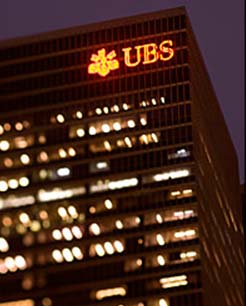 Code names, secretive European royalty, encrypted computers. A spy novel? Nope. Nope. It’s how two European banks helped rich Americans duck the taxman, a Senate probe found.
The Newport regatta has always drawn America’s moneyed class, and the Art Basel show in Miami is hot on the nouveau riche circuit”making both glitzy venues ideal for financial giants to prospect for new clients.
But UBS, one of the world’s largest banks, had another goal in mind when it shelled out money for the UBS Regatta Cup in Newport or the Art Basel Art Fair in Miami, or performances in major U.S. cities by the UBS Vervier Orchestra.
Blog, Offshore, Regulation & enforcement
March 26, 2008 –
Lawrence Summers spoke at the Council on Foreign Relations last week and was a bit uncomfortable about my question regarding Clinton administration anti-money-laundering policy.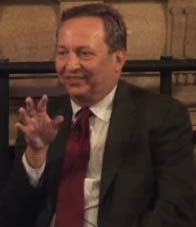
I pointed out that Treasury Secretary Robert Rubin (who happens to be one of the Council‘s co-chairs) had not acted against money-laundering because he didn‘t want to stop the free flow of cash into the US – in effect, into Wall Street. But when Summers succeeded Rubin in the job, he had taken action.
The facts are important because Rubin is poised to move into a Democratic administration — especially if Clinton wins — as a high-level Wall Street influential.
Offshore, Regulation & enforcement, Scoops
Speech to conference on Taming the Giant Corporation, organized by Ralph Nader and The Center for Study of Responsive Law, Washington DC, June 8, 2007
The tax haven racket is the biggest scam in the world. It‘s run by the international banks with the cooperation of the world‘s financial powers for the benefit of corporations and the mega-rich. This talk is about strategy, but first you have to know the target, and most Americans, including progressive activist Americans, don‘t know what I‘m going to tell you. And that‘s part of the problem.
Between 1996 and 2000, of U.S. and multi-national corporations operating in the United States, with assets of at least $250 million or sales of at least $50 million, nearly two-thirds paid no U.S. income tax. Over 90 percent reported owing taxes of under 5 percent. One year, six in ten paid less than a million.
This is the dirty little secret of globalization: the end of controls on capital flows and the expansion of the tax haven system from 25 years ago to where it has more than doubled to about 70 tax havens.
The system is a major reason for the growing inequality in the U.S. and between the West and the developing worlds.
The system has given the big banks and corporations and the super-rich mountains of hidden cash they use to control our political systems.
Banks, Corporate Abuses, Major Past Articles, Offshore, Regulation & enforcement, Scoops
Is Citibank Spain a tax cheat?
New Internationalist, Aug 2006

With help from a whistleblower, I followed the money trail through the offshore operations of Citigroup, the world‘s biggest bank, and discovered that Spanish bankers handling their client’s offshore accounts were getting commissions via an internal accounting system instead of on the regular books.
It is the same internal system that Citigroup used in the 1970s to compensate currency traders in Paris, London, Frankfurt and elsewhere who booked trades in the tax haven Nassau, the Bahamas. They were exposed by an insider, were investigated by the SEC and Congress, and had to pay millions in back taxes. Is this happening again?
Corporate Abuses, Regulation & enforcement, Scoops
Hound-Dogs, March 2004
(Same title but not same article as in Dissent 2003)
This is a story about a massive money-laundering operation run by the world‘s biggest banks. It hides behind the “eyes-glazing over” technicalities of the international financial system. But it could be one of the biggest illicit money-moving operations anyone has ever seen. And it‘s allowed to exist by the financial regulators who answer to Western governments.
In these days of global markets, individuals and companies may be buying stocks, bonds or derivatives from a seller who is Clearstreamhalfway across the world. Clearstream, based in Luxembourg, is one of two international clearinghouses that keep track of the “paperwork” for the transactions.
Offshore, Regulation & enforcement, Scoops
In These Times, Oct 22, 2001
Offshore banking has helped Citibank clients hide millions.
Citibank Citibankis leading a fight by American banks to gut the anti-moneylaundering laws currently being considered in Congress”laws that could significantly change the way banks do business for their wealthiest clients.
Citibank is seeking an exception to a proposed ban on doing business with shell banks, which have no physical presence and are situated “virtually” in offshore zones to avoid taxes and regulations. The banks are used to hide and launder perhaps billions of dollars a year.
Offshore, Regulation & enforcement, Scoops
Earth Times News Service, May 18, 2001
In the first salvo of an international effort to disable the system of shell companies used widely by criminals, corrupt officials, and tax cheats, the OECD Council of Ministers on May 10th adopted a report on what countries should do to pierce shell company secrecy. Called “Misuse of Corporate Vehicles for Illicit Purposes,” it is part of a campaign by the world‘s financial powers against the illicit offshore bank and corporate secrecy system. It was written by OECD Steering Group on Corporate Governance made up of experts from member countries‘ finance and securities ministries.

